
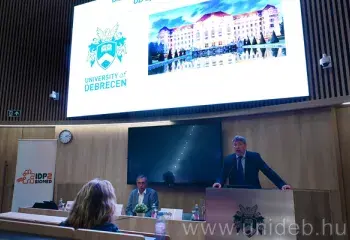
In 2026, the University of Debrecen hosted the annual meeting of the Hungarian Biochemical Society, which will be held in conjunction with an international conference. The event is the most prestigious domestic forum in the field of biochemistry, featuring scientific presentations and professional discussions, and two faculty members from the university will also receive prestigious professional recognition. The three-day conference opened on Wednesday, August 26, at the Learning Center.
News
A more thorough recognition and understanding of the various cell types in cartilage may lead to the development of new therapeutic options for the treatment of osteoarthritis. The latest research findings on this topic have been analyzed and synthesized by Csaba Matta, a researcher at the University of Debrecen, and his co-authors. His review article is now published in Nature Reviews Rheumatology, one of the leading journals of the field. The scientific achievements of his work have also been recognized by earning a Publication Award from the University of Debrecen and the Count István Tisza Foundation for the University of Debrecen.
Researchers at the Faculty of Engineering of the University of Debrecen have investigated a physico-chemical treatment method for so-called bathroom greywater (BGW). This is water that has already been used once in the bathroom (gently) but can be reused for certain non-potable purposes after treatment. The findings were published in the journal Results in Engineering. This article has also been honored with a Count István Tisza Foundation for the University of Debrecen and the University of Debrecen Publication Award.

Bertalan Meskó is a “medical futurist” who believes that practical methods of futures studies, like foresight and scenario analysis, should play a greater part in scientific decision-making. In his view, the examination of possible futures and risks could turn out to be helpful in planning research programs more flexibly and in making well-informed decisions concerning research funding. Together with his co-authors, he has published his proposals related to this topic in Nature, one of the most prestigious scientific journals in the world. Meanwhile, Bertalan Meskó is already busy establishing a workshop at the University of Debrecen focused specifically on medical futures studies.

A research team at the Faculty of Health Sciences of the University of Debrecen has explored the connection between periodontal disease, as a risk factor for neurodegenerative diseases (NDDs), and its possible inflammatory, microbial and genetic background. The research team members concluded that periodontitis is normally associated with a heightened risk of developing later neuro-degenerative diseases, even after having been accounted for cardiovascular, cerebrovascular, metabolic and inflammatory comorbidities.